
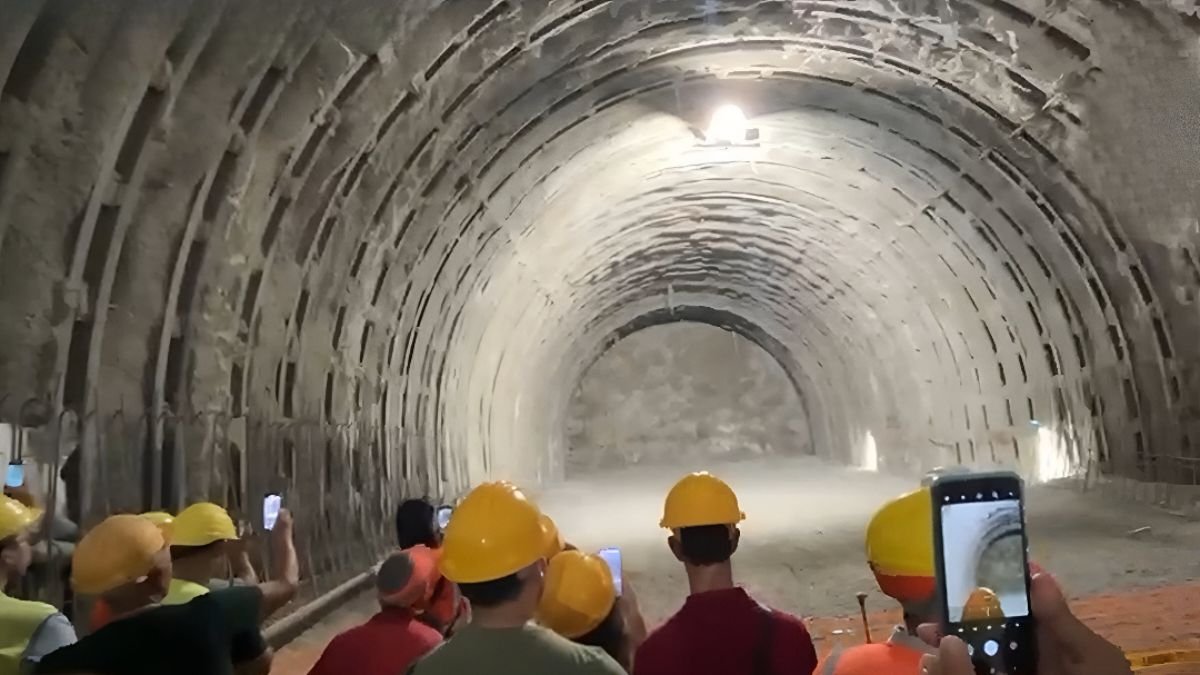
If you’ve ever traveled by train in Switzerland, you’ve likely experienced that moment when the lights suddenly disappear, a slight pressure in your ears, and your own reflection in the window. For most travelers, this is simply a normal part of everyday travel—time to check your mobile phone or think about what’s for dinner.
But beyond that glass, deep within the mountains, a monumental task is underway that few people consider. In fact, you’re not just passing through a tunnel—you’re traveling through an entire “other country,” carved out of rock over the past 30 years. This other country is made up of roads, rail lines, and energy systems, and its purpose is not only to ease travel but also to protect the climate and the environment.
Another country nestled beneath the mountains
Switzerland today has more than 1,400 tunnels. The total length of these tunnels and underground galleries exceeds 2,000 kilometers. This includes railway tunnels under the Alps, road tunnels for national highways, and hidden galleries built for water and electricity.
In terms of length alone, this underground network rivals the metro and transport systems of many major cities. The only difference is that the entire system is hidden underground—quiet, organized, and almost invisible.
The most famous part of this “hidden country” is the New Rail Link through the Alps (NRLA). This is a mega project, combining three massive base tunnels—Loetsberg, Gotthard, and Ceneri—to create a flat rail corridor beneath the mountains. Of these, the Gotthard Base Tunnel is the most notable, at approximately 57 kilometers long and considered the world’s longest railway tunnel. A passenger train traverses it in approximately 20 minutes.

Beyond convenience, the real reason is the environment.
At first glance, all this might seem like a mere convenience. Avoiding mountain curves, reducing travel time, and avoiding being stuck behind trucks. But for the Swiss government, the real reason was something else.
The primary objective of the NRLA is to shift freight from road to rail, thus protecting fragile mountain regions like the Alps from pollution. The Swiss government clearly states that this project is designed to protect the Alps.
Trains instead of trucks: Relief for the valleys
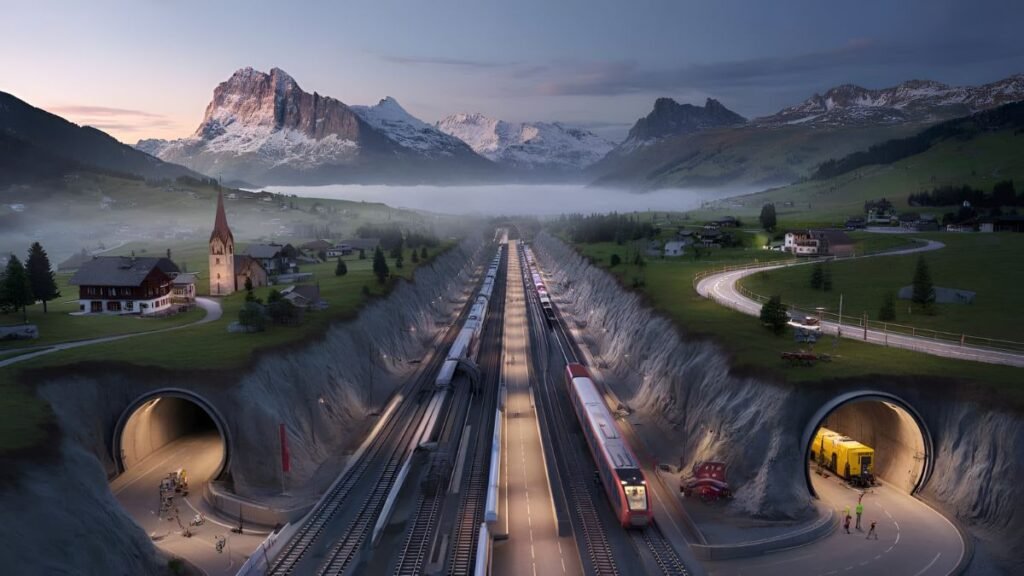
There was a time when heavy trucks constantly passed through the narrow valleys of the Alps. Diesel smoke filled small villages, pollution was trapped between the mountains in the summer, and the winding roads posed a constant risk of accidents.
In the 1990s, Swiss citizens, through the Alpine Initiative, made a significant decision—shifting long-distance freight transportation from trucks to trains. But this decision wasn’t just left on paper. Tunnels are the “hardware” that made this promise a reality.
Longer, heavier freight trains can now traverse mountains with less energy thanks to flat underground routes. Research shows that per tonne-kilometer, trains use about one-fifth the energy of trucks and have only about one-quarter the greenhouse gas emissions.
The Impact of Change Is Visible in the Data
The impact of these policies and tunnels is clear. Today, more than 72 percent of goods crossing the Alps in Switzerland are transported by rail. While approximately 1.4 million trucks crossed the Alps in 2000, this number had decreased to around 940,000 by 2018.
Analysts estimate that if Switzerland had not adopted this policy, approximately 650,000 additional trucks would have crossed the mountains in 2016. In 2017 alone, approximately 700,000 tons of CO₂ emissions were avoided.
However, the work is not yet entirely complete. Even in 2022, approximately 880,000 trucks were still crossing the Alps. This means the target is within reach, but the journey is not yet over.
For the people living in the valleys, this means something very simple—quieter nights, cleaner air, and less danger on the roads.
Construction within the Mountains, but with Respect for Nature
Excavating such massive tunnels is not without consequences. For the Gotthard Base Tunnel alone, approximately 28 million tons of rock were removed. The use of concrete and steel was also substantial, resulting in a significant carbon footprint.
But Swiss planning didn’t stop there. Special measures were taken to minimize environmental damage during construction. Most materials were transported by rail or ship, machines were equipped with filters, and wastewater was treated before being released into rivers.
After completion, riverbanks were restored to their natural state, stone walls were rebuilt for small animals, and efforts were made to return the environment to its original condition as much as possible. The philosophy was clear—if you go deep into the earth, you must compensate for it on the surface.
The Advantage of Hidden Structures in a Changing Climate
Underground infrastructure not only reduces pollution but also increases safety. In events such as avalanches, rockfalls, and heavy rainfall, tunnels and galleries help keep roads and rail lines open. As extreme weather events become more frequent due to climate change, these underground structures are becoming increasingly vital.

What can the world learn from Switzerland?
Switzerland’s “second country” wasn’t built overnight. It’s the result of decades of political consensus, engineering planning, and sustained funding. The clear lesson here is that simply building tunnels isn’t enough.
Real change happens when robust rail networks, pricing that reflects environmental costs, and strong policies are implemented in tandem.
Back on the train…
When you’re standing on that quiet underground platform, coffee in hand, watching the weekend weather, it can all seem very abstract. You simply notice that the train arrived on time.
But it’s this reliable, seemingly ordinary journey that gives people the confidence to leave their cars behind and embrace public transport. And beneath this trust, within the mountains, that “second country” is quietly changing the course of the climate.
FAQs
Q. What is Switzerland’s “second country” beneath the Alps?
A. It refers to a vast underground network of over 1,400 tunnels and 2,000 km of rail, road, and utility passages.
Q. Why did Switzerland build so many tunnels?
A. The main goals were to reduce road traffic, protect the Alps, and lower pollution by shifting freight from trucks to trains.
Q. What is the Gotthard Base Tunnel?
A. It is the world’s longest railway tunnel, running about 57 km under the Alps.
Q. How do these tunnels help the climate?
A. They reduce truck traffic, cut fuel use, and lower greenhouse gas emissions by moving freight to rail.
Q. Can travelers see this underground network?
A. Most of it is hidden; travelers experience it only briefly while passing through tunnels by train or road.
