
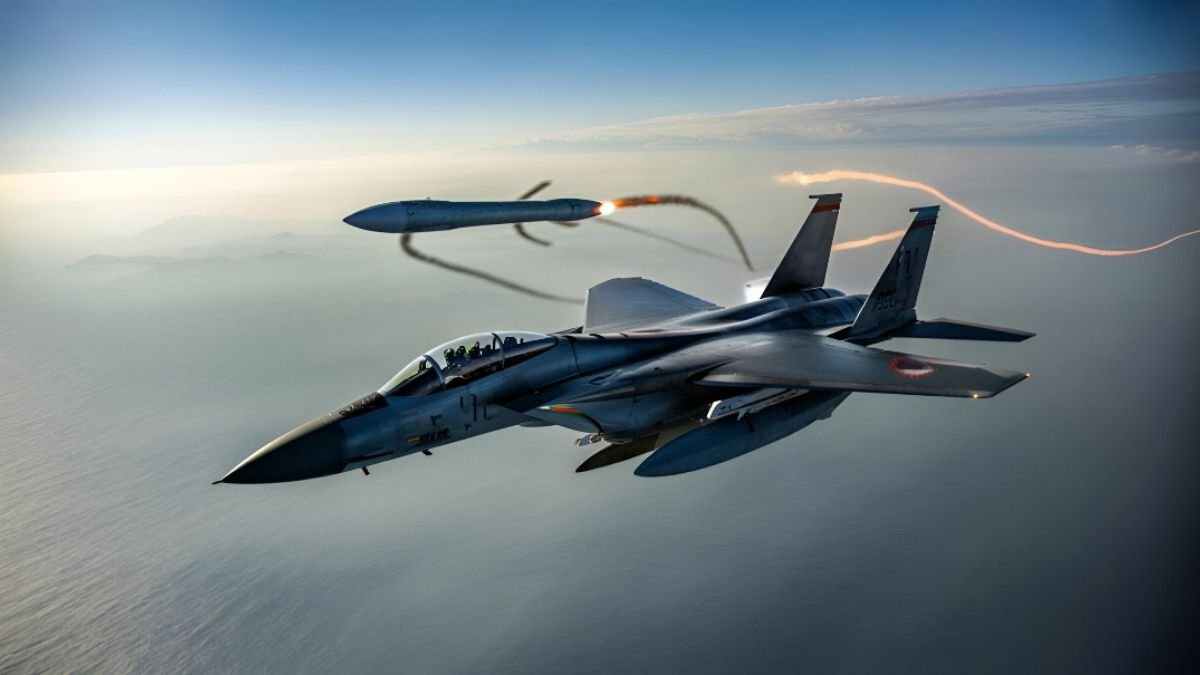
It’s a hazy morning over the Pacific Ocean. A gray Japanese F-15 fighter jet slowly emerges from the clouds. Almost silent and alone. Something new hangs beneath its wing—a long, dark, and angular object, devoid of any distinguishing markings and radiating a sense of silent menace. The object remains invisible until it’s too late.
The pilot steadies the aircraft. A calm voice is heard in the headset. The missile drops, disappears into the air, and then suddenly, with a bright flash, accelerates towards its target. For a moment, the sky seems empty. Then, telemetry screens on the ground light up, data flashes, and the reality of the “red line” that had been considered purely theoretical for decades becomes clear.
Japan’s New Missile: Redefining the Straight Line
Japan’s new missile no longer follows the straight-line trajectory of old. It twists, turns, corkscrews, and evades radar detection to reach its target. Technically, it’s a long-range standoff missile with a range exceeding 1,000 kilometers. But its significance lies not just in its range. It’s a strategic message: “We are no longer just defending; we are developing a new capacity for response and control.“
The missile’s design and programming are intended to confuse modern air defense systems. Stealth shaping, low-altitude flight, and unpredictable serpentine maneuvers—all combine to make the missile difficult to intercept. On radar screens, the defender sees only a ghost, and then the explosion is reported—realizing that their base is no longer safe.

Development of the Type 12 Surface-to-Ship Missile
The Type 12 surface-to-ship missile was previously used only for coastal defense, with a range of less than 200 kilometers. But in recent years, Japan has secretly modernized it. Its airframe is now stealthy, the seeker is smart, and the range has increased to over 1,000 kilometers.
In addition, the new missiles are integrated with “loyal wingman” drones and upgraded F-35 fighters. The aircraft no longer need to penetrate enemy territory. They launch missiles from a safe distance, which then reach their targets via unconventional trajectories. What was once merely a coastal defense tool is gradually becoming a strategic weapon.
Regional Security and Political Equations
China, North Korea, and the United States closely monitor every Japanese test, every press leak, and every budget allocation. For decades, Japan refrained from developing offensive weapons capabilities. Even the terminology was altered to suggest that “defense” could sometimes mean striking enemy bases first.
But now Tokyo openly speaks of “counterstrike capabilities.” The weapons can now penetrate deep into foreign airspace, performing corkscrew maneuvers to evade interceptors. Legal limitations still exist, but they are being gradually stretched. When a country with such technological and industrial prowess embarks on this path, the regional security equation changes instantly.
Crossing the Red Line: A Mental and Strategic Shift
Officials in Japan’s Self-Defense Forces don’t see this as merely a technological change. It’s a mental and strategic shift. For decades, their job was simply to “hold the line” and wait for assistance. Now they are practicing scenarios where Japanese units launch stealthy, corkscrew-maneuvering missiles at North Korean launch sites or ships in the East China Sea.
The method is superficially simple: disperse the launchers, hide them on trucks and remote islands, link them to satellites and AWACS aircraft, and send the missile on a pre-programmed trajectory. Low-altitude flight, close-to-the-ground maneuvers, serpentine movements, and random course changes—all these dangerous actions are performed by the missile itself, not by a pilot or aircraft.
Technical Details: Corkscrew Flight and Stealth
The new Japanese corkscrew missile is a blend of several technologies:
- Low-altitude flight: To evade long-range radar.
- Stealth and radar-absorbent materials: Resulting in less energy reflected back to the radar.
- Infrared seeker: To ensure target acquisition in the final stage.
- Spiral and wave movements: To confuse interception algorithms.
These techniques complicate the mathematical processes of air defense systems. Interceptors require a predictable trajectory, but this missile constantly changes its course.
Political and Social Implications
Political debate in Japan is heated but weary. Older generations recall postwar promises—“never aggressive, never the first to attack.” Younger voters watch defense news on their smartphones and experience a different world: hypersonic tests, drone swarms, and ballistic launches.
Analysts say: If Japan doesn’t cross this red line, it will become a soft target. Peace activists say, “The more weapons you build to attack distant bases, the more likely they are to be used first.” Meanwhile, ordinary people go about their lives while their country’s missiles learn new tricks.
The Impact of Corkscrew Flight on the Battlefield
Technologically, this missile reduces the reaction time of defenders. With long range, low visibility, and unpredictable trajectories, no base is now safe. The definition of distance has changed.
Japan’s former defense minister said, “If we are not able to strike back at those who attack us, then we are simply waiting for the first blow.” This statement resonated in all the region’s capitals.

Conclusion: From Defense to Counterstrike
The new missile doesn’t just twist its way through the sky; it also twists old perspectives and Japan’s defense policy. Distance no longer feels safe, and the regional security landscape has shifted. Whether this makes the region safer or more vulnerable is a question that won’t be answered on any radar screen. The balance hangs between fear and retaliation, security and temptation.
Japan’s new missile program is not only a technological marvel but also a symbol of a strategic and psychological shift. It reflects the country’s struggle to find a new balance between its pacifist history and current security challenges.
FAQS
Q. What is unique about Japan’s new missile?
A. It can perform mid-air corkscrew maneuvers and fly under radar, making it difficult to intercept.
Q. How far can the missile reach?
A. The missile has a range of over 1,000 kilometers, allowing it to strike distant bases, ships, or infrastructure.
Q. Is this missile purely defensive?
A. No. While Japan calls it part of self-defense, its range and capabilities give it counterstrike potential.
Q. How does the missile evade air defenses?
A. Through low-altitude flight, stealth shaping, spiral maneuvers, and advanced seekers that confuse radar and interception systems.
Q. Why is this missile significant regionally?
A. It changes the strategic balance in East Asia, prompting reactions from China, North Korea, and the US, and alters assumptions about Japan’s defense posture.
